Verified BM for Sale: How to Compare Supplier Offers
Searching for verified BM for sale can produce proposals that look similar but include very different responsibilities. One supplier may quote for setup assistance, another for access to specific assets, and another for a broader implementation project.
Before comparing prices, establish whether the proposals address the same business need.
This guide provides a practical framework for evaluating supplier offers, identifying missing information, and agreeing on measurable deliverables before payment.
1. Send Every Supplier the Same Brief
A useful comparison starts with consistent requirements.
Prepare a short brief explaining:
-
Your business name and website.
-
The purpose of the proposed setup.
-
Your existing business portfolio and assets.
-
The problem you need help resolving.
-
The people who need access.
-
Any configuration or integration work required.
-
Your preferred implementation schedule.
For example:
We operate an online retail business and already manage a website and Facebook Page. We need an assessment of our existing business setup, assistance with the identified requirements, and documented access for our internal team.
Ask each supplier to respond to that brief. If one proposes a different arrangement, request a separate explanation of its scope and dependencies.
2. Clarify What “Verified BM for Sale” Means in Each Offer
Do not assume that the same product label means the same service.
Ask each supplier to identify whether its proposal covers:
-
Assistance with your existing business portfolio.
-
Preparation of business verification materials.
-
Configuration of particular assets.
-
Authorized access to assets managed by another organization.
-
An authorized handover arrangement.
-
Development, testing, or ongoing support.
If another organization is involved, ask which business the setup represents and how your company is authorized to use it.
Treat access, business identity, and ownership as separate questions. Require the supplier to explain the proposed arrangement and identify the current platform requirements that apply.
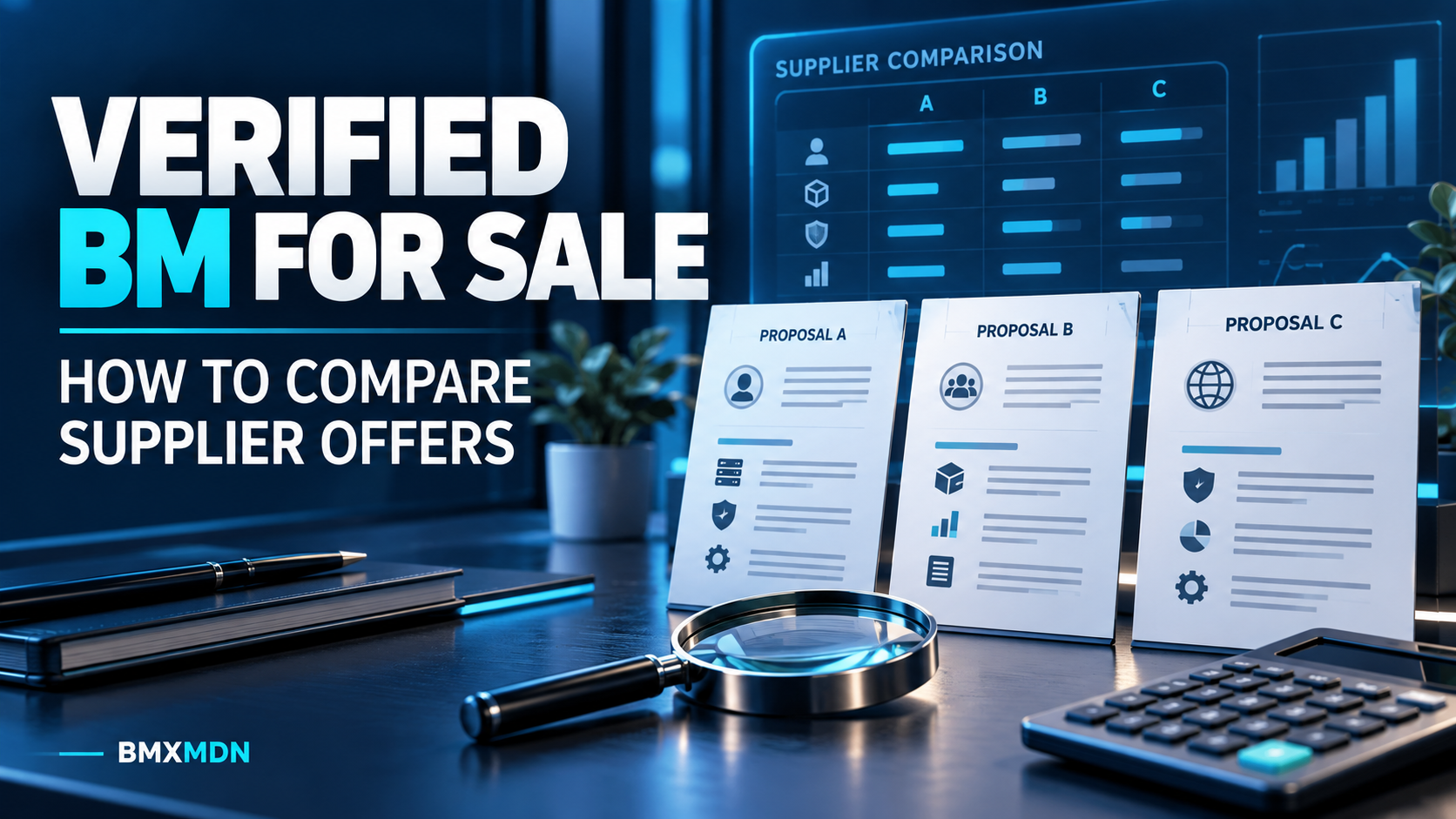
3. Build a Comparison Table Before Discussing Discounts
Organize responses in a table so missing information remains visible.
| Comparison area |
Information to request |
| Business identity |
The organization represented and its relationship with the supplier |
| Access |
Named users, permissions, and who retains control |
| Included assets |
A specific list of portfolios, Pages, accounts, or applications |
| Configuration |
Settings and implementation tasks included |
| Acceptance |
Checks used to confirm completion |
| Schedule |
Supplier work, your responsibilities, and external dependencies |
| Costs |
Initial fees, recurring charges, and exclusions |
| Support |
Duration, covered issues, and response expectations |
| Exit arrangements |
Documentation, access changes, and unfinished work |
Mark unanswered items as “not confirmed.” Avoid treating a missing answer as an included service.
A detailed proposal gives you more to evaluate than a short message promising immediate delivery.
4. Separate Supplier Work from External Decisions
Ask suppliers to distinguish tasks they perform from outcomes that require action by another party.
For example, document preparation, configuration, and training can be described as supplier deliverables. Any external review should be identified as a dependency with its own uncertainty.
Request a schedule showing:
-
What the supplier can start immediately.
-
What information your team must provide.
-
Which steps depend on other organizations.
-
How delays will be communicated.
-
What happens if the proposed approach cannot proceed.
If an offer promises a fixed completion date, ask exactly which deliverable will be complete by that date.
This prevents a setup deadline from being mistaken for a commitment covering every subsequent review or integration.
5. Compare Costs Over the Same Period
An initial price does not show the full cost of an arrangement.
Choose a comparison period, such as the first three months, and ask each supplier to list charges within that period.
Include:
-
Assessment and setup fees.
-
Configuration or development work.
-
Training and handover.
-
Required subscriptions.
-
Maintenance and support.
-
Optional work likely to be needed.
-
Applicable taxes or transaction charges.
Keep advertising expenditure separate from service fees so you can compare like-for-like proposals.
Where a cost depends on usage, request the pricing basis and an estimate using your expected volume. Label estimates clearly.
6. Link Payment Milestones to Inspectable Deliverables
Discuss payment stages alongside acceptance criteria.
An illustrative structure might separate assessment, implementation, and handover. The appropriate arrangement depends on the project, but each stage should describe what your team can inspect.
For example:
-
Assessment: written findings and a proposed scope.
-
Configuration: agreed settings and permissions checked.
-
Handover: documentation delivered and outstanding tasks recorded.
Clarify how disagreements about completion will be handled before work starts.
If a supplier requests full payment upfront, ask how incomplete work, cancellation, and unresolved dependencies are addressed in the written agreement.
7. Compare Support and Exit Arrangements
Support should be described in operational terms.
Ask who receives requests, what information they need, and how quickly they aim to respond. Distinguish troubleshooting from new configuration or development.
Also establish what happens when the relationship ends:
-
Which documentation will your team retain?
-
Which subscriptions must continue?
-
What access will the supplier retain or remove?
-
Who handles unresolved tasks?
-
Can your team continue the agreed operations independently?
A proposal should make these dependencies understandable before you commit.
Example: Two Offers with Different Scope
Consider two hypothetical proposals.
Offer A includes an initial configuration task. Offer B includes the same task, access checks, a handover document, and a defined support period.
The difference in price cannot be assessed fairly until you know whether your team needs the additional work.
Ask Supplier A to price the missing items. Ask Supplier B whether any optional items can be removed. You can then compare equivalent scopes instead of choosing from headline prices.
Supplier Comparison Inquiry Template
“Hello, we are comparing verified Business Manager service proposals for [business and purpose]. Please respond to the attached scope and specify the business represented, authorization arrangement, included assets, access permissions, deliverables, acceptance checks, external dependencies, total costs, payment milestones, support, and exit arrangements. Please identify all exclusions.”
Frequently Asked Questions
Is the lowest-priced verified BM offer the best choice?
Price becomes meaningful when the scope is comparable. Check what is included, what remains your responsibility, and which charges may follow.
How should I handle an unclear proposal?
Ask for written clarification before accepting it. Keep unresolved items visible in your comparison table.
Can a supplier’s screenshot replace acceptance testing?
Use screenshots as supporting context. Agree on checks that demonstrate the specific permissions and functions your team needs.
What if I already have a business portfolio?
Request a proposal for assistance with your existing setup. Compare it with any alternative arrangement using the same requirements.
Request a Proposal You Can Compare
Prepare one clear brief and use it consistently when evaluating verified BM for sale offers. Focus on business identity, authorized access, defined deliverables, total costs, and support responsibilities.
If you need assistance reviewing your situation, visit BMXMDN to discuss your requirements. Request a proposal covering your existing setup, implementation scope, acceptance checks, costs, and ongoing support.