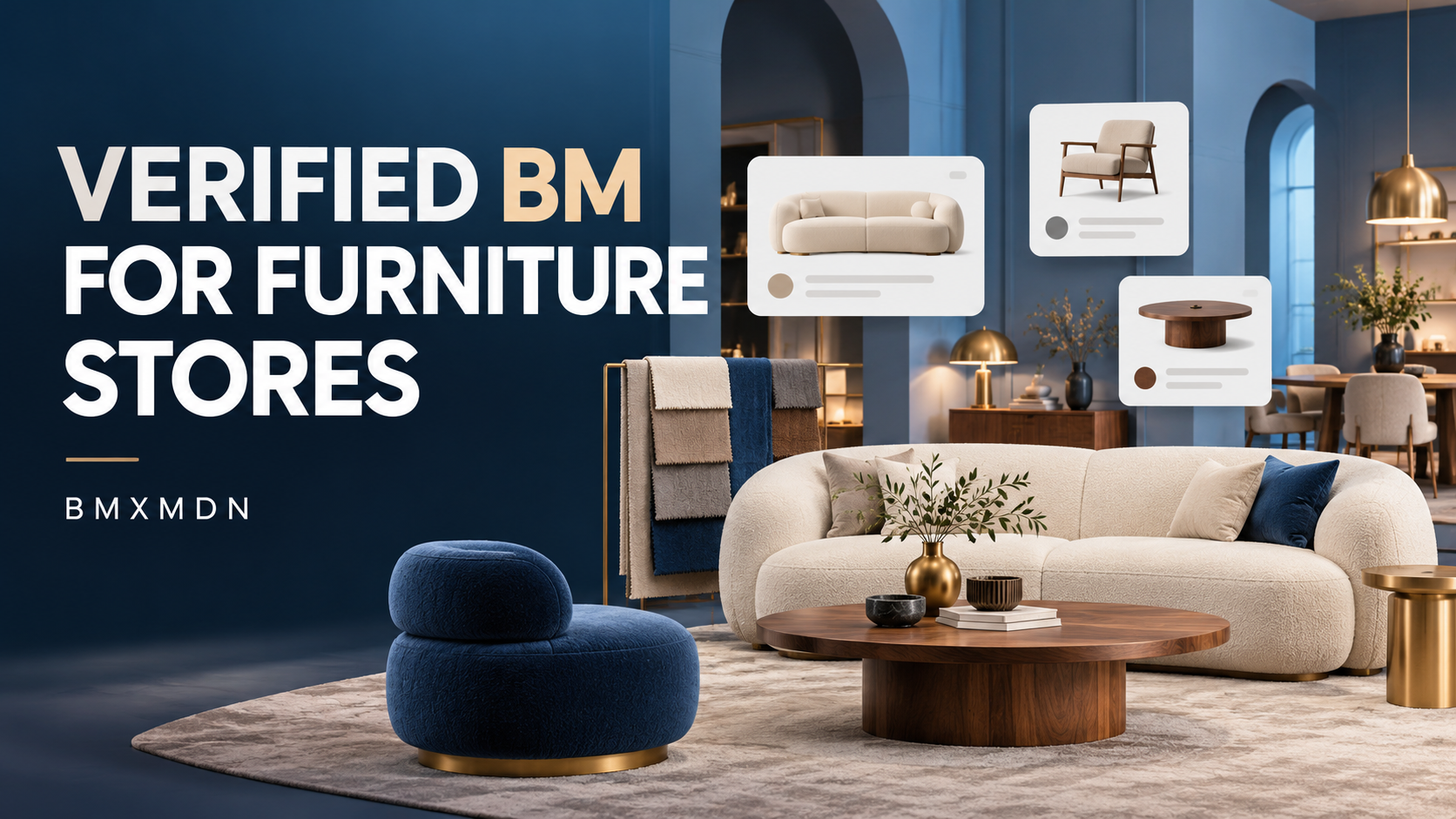
Verified BM for Furniture Stores: A Buying Guide for Retailers
Searching for a verified BM for furniture stores often begins with a specific business need: organizing existing assets, preparing a product connection, or getting assistance with an incomplete business setup.
For a furniture retailer, that setup may support several customer journeys. One shopper wants to visit a showroom. Another needs a quote for a particular sofa configuration. A third wants to confirm whether a dining set can be delivered to their area.
Before choosing a provider, identify which of these activities the proposed service will support. A portfolio-related offer alone does not explain whether product preparation, inquiry handling, website work, or ongoing maintenance is included.
Start with How Your Store Sells
Describe your retail model before requesting a quotation.
Do you sell stocked furniture, made-to-order pieces, custom designs, or a combination? Can customers purchase online, or must a salesperson confirm the details first?
Prepare a short brief covering:
-
Your business name and website.
-
Showroom locations.
-
Main product categories.
-
Existing business assets and software.
-
How customers request information or place orders.
-
The specific setup problem you need to resolve.
For example:
We operate two furniture showrooms and a website displaying sofas and dining sets. Customers request a quote before ordering. We need business setup assistance and an assessment of how product inquiries reach the appropriate showroom.
This gives a provider enough context to separate administrative assistance from additional technical work.
1. Understand the Arrangement Behind the Offer
Ask what the advertised package actually provides.
It might include help preparing your own business verification submission, configuration of existing assets, or an ongoing management service. Request a written explanation of the business represented by the setup and the provider’s responsibilities.
If another organization’s portfolio or application is involved, ask how that arrangement is authorized and what your business will control.
Clarify:
-
Which assets already exist.
-
Which assets the provider proposes adding.
-
What access your team will receive.
-
What remains dependent on the provider.
-
What happens when the service ends.
If you want verification assistance for your own furniture business, state that explicitly. Ask the provider to assess the current official requirements relevant to your intended use.
2. Separate Business Setup from Retail Implementation
A proposal should distinguish verification-related assistance from the work required to support your store’s customer journey.
| Service area |
What to clarify |
| Business verification assistance |
Information review, preparation, and submission support |
| Asset configuration |
Assets involved and settings to be reviewed |
| Product preparation |
Images, descriptions, dimensions, and variants covered |
| Inquiry handling |
Forms, destinations, and assignment rules |
| Website development |
Pages, code changes, and dependencies |
| Testing |
Functions and customer scenarios to demonstrate |
| Ongoing support |
Maintenance boundaries and additional charges |
Ask for an observable deliverable in each included area.
For example, “product preparation completed” should identify the products reviewed and the information checked. “Inquiry setup completed” should describe where a test request arrives and what details it contains.
3. Make Product Configurations Understandable
Furniture inquiries can become difficult to interpret when product names leave important choices unspecified.
A sofa may have several sizes, fabrics, colors, and layouts. A dining table may come in different lengths or finishes. Ask how the proposed product work will preserve those distinctions.
If relevant to the agreed scope, identify:
-
A stable product or model reference.
-
Dimensions and measurement units.
-
Material and finish options.
-
Available configurations.
-
Items included in the displayed price.
-
Details requiring confirmation before ordering.
For example, a room photograph might show a table, six chairs, lighting, and decorative accessories. Your team should decide how the listing explains what is included.
Also distinguish showroom display availability from stock available for sale. Ask which source will maintain each piece of information if product updates are part of the service.
4. Design Inquiries Around the Next Useful Conversation
If inquiry handling is included, define the information your sales team needs to respond.
An initial request might capture the product reference, preferred configuration, delivery area, and whether the customer wants a showroom visit or quotation.
Avoid collecting detailed information before it becomes necessary. A general delivery area may be enough for an initial discussion; access measurements or installation details can follow when relevant.
Agree on how requests are assigned:
-
By the customer’s chosen showroom.
-
By service area.
-
By product category.
-
To an existing salesperson.
-
To a shared team when no individual is available.
The acknowledgment should describe the actual next step. A request received should not be presented as a confirmed appointment, accepted order, or delivery reservation unless that outcome has been established.
5. Define Who Confirms Price, Stock, and Delivery
Document which system or team maintains information that affects a customer’s decision.
| Information |
Responsibility to agree |
| Product specifications |
Who approves dimensions, materials, and descriptions |
| Selling price |
Who updates prices and checks promotional conditions |
| Availability |
Which source distinguishes stock from display pieces |
| Production timing |
Who confirms estimates for made-to-order furniture |
| Delivery coverage |
Who assesses the destination and service required |
| Installation |
Who confirms whether assembly or fitting is included |
If the provider proposes automated updates, ask what happens when the source is unavailable or the information is incomplete.
Do not assume that general business setup includes inventory synchronization, delivery scheduling, or custom quotation software. Request separate scope and pricing for those functions.
6. Test Realistic Customer Scenarios
Choose test cases that reflect the questions your store receives.
A useful acceptance check could include:
-
An inquiry about a specific fabric and sofa layout.
-
A customer selecting a preferred showroom.
-
A product with incomplete dimensions.
-
A discontinued finish still referenced in an older inquiry.
-
A request from outside the usual delivery area.
-
A duplicate submission.
-
A salesperson handing an inquiry to another team member.
Record the expected result, actual result, and any unresolved issue.
Use test information where practical. If existing customer records are necessary, agree on appropriate access and handling.
Keep completed implementation work separate from external platform decisions. Ask the provider to document what it configured or submitted and which outcomes remain outside its control.
7. Compare the Cost of Keeping the Setup Useful
A lower initial quotation may cover fewer products, fewer test scenarios, or a shorter support period.
Compare proposals using the same scope. Ask whether later work is charged separately, including:
-
Adding a new collection.
-
Updating product configurations.
-
Opening another showroom.
-
Changing inquiry assignment rules.
-
Repairing an external connection.
-
Training replacement staff.
Before accepting delivery, request an asset inventory, configuration notes, test results, outstanding tasks, and maintenance responsibilities.
Include an access review in the handover. Your business should understand who can make changes and why any provider access continues.
Inquiry Template for Furniture Retailers
Hello, we operate [store name] at [website URL] with [number] showroom locations. We sell [product categories] through [online checkout, quotations, showroom sales, or a combination]. We need assistance with [specific business setup tasks]. Our current assets and systems are [brief description]. Please provide an itemized proposal covering business identity, asset control, product information, inquiry handling, testing, handover, recurring costs, and support. Please quote website development and inventory integration separately if required.
Frequently Asked Questions
Does a verified BM include furniture catalog setup?
Do not assume it does. Ask the provider to specify whether product preparation, connections, and ongoing updates are included.
Can I request assistance for a showroom-only business?
Describe your intended use and the problem you need to solve. The proposal should reflect your actual sales process rather than assume online checkout is required.
Can the service support made-to-order furniture?
Clarify the exact work involved. Configuration choices, quotation handling, and production estimates need their own scope if the provider will help implement them.
Should each showroom have a separate setup?
Start with the business structure, existing assets, and management responsibilities. Ask the provider to explain its proposed arrangement before creating additional components.
Does business verification guarantee more furniture sales?
No. Verification status alone does not establish product demand, inquiry quality, customer experience, or sales performance.
Request a Proposal for Your Furniture Business
Prepare your website, showroom details, existing asset information, and examples of the customer inquiries your team handles.
If you need assistance reviewing your situation, visit BMXMDN to discuss your business verification and furniture retail setup requirements.
Request a proposal through BMXMDN with a clear scope covering asset control, product configurations, showroom inquiries, testing, handover, and ongoing support.